Health plans invest in utilization management software expecting it to handle the full scope of medical necessity reviews. For many payers, those tools were built for a simpler era of authorization workflows and clinical criteria.
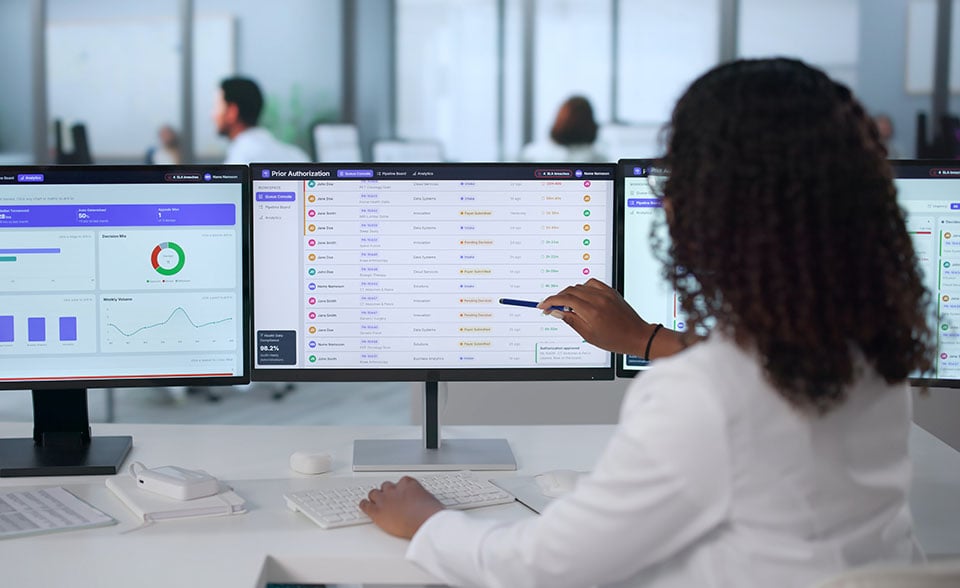
As review volumes climb and regulatory requirements intensify, the gap between what traditional UM platforms can do and what health plans actually need becomes impossible to ignore. This article identifies eight pressure points where that gap shows up and what forward-thinking payer organizations are doing about it.
Key Takeaways: Why Health Plans Outgrow UM Software
- Traditional utilization management software relies on static rules that cannot keep pace with dynamic medical necessity reviews.
- Rising review volumes and increasing clinical complexity quickly overwhelm UM tools designed for simpler authorization workflows.
- Disconnected data across claims, clinical, and pharmacy systems limits real-time decision support for UM nurse reviewers.
- Regulatory pressure from CMS-0057-F and state-level prior authorization mandates demands capabilities most older UM platforms lack.
Where Traditional UM Software Falls Short for Health Plans
1. Static Rules Can't Keep Pace with Evolving Clinical Criteria
Most traditional utilization management software was designed around fixed decision trees and manually maintained rule sets. When payer-specific criteria change, staff update spreadsheets or configuration files one at a time.
That approach worked when authorization volumes were lower and clinical guidelines updated less frequently. Today, health plans manage thousands of unique clinical scenarios across commercial, Medicare Advantage, and Medicaid lines of business.
The gap between the pace of guideline updates and the speed of rule maintenance creates a structural risk: outdated criteria applied to current cases, resulting in inappropriate denials or approvals that invite regulatory scrutiny.
2. Siloed Data Blocks Holistic Member Visibility
Effective medical necessity review depends on a complete clinical picture. Reviewers need concurrent access to claims history, pharmacy fills, lab results, and provider notes to make sound determinations.
Older UM platforms typically pull from a single data source or require reviewers to toggle between disconnected systems. A 2025 KPMG report on utilization management found that outdated technologies and high operational costs associated with extensive reviews are proving unsustainable for payers long-term.
Without a unified member profile, reviewers lack the context needed for confident, clinically sound decisions. That missing context adds turnaround time and increases the likelihood of appeals.
3. Manual Workflows Create Bottlenecks at Scale
According to JAMA Network Open (2025), clinically integrated prior authorization software reduced denials by 65% and cut median authorization time by nearly 34%. The contrast highlights how much friction manual UM workflows still introduce.
When nurse reviewers spend their time on data gathering, faxing, and portal navigation, the hours available for clinical judgment shrink. Health plans relying on phone-based submission face compounding backlogs as prior authorization volumes grow.
The result is a UM operation that scales linearly with headcount rather than with technology.
4. Limited Automation Stalls Medical Necessity Determinations
Many UM platforms offer basic auto-approval for straightforward cases. But the cases that consume the most reviewer time are the complex ones: multi-comorbidity patients, high-cost specialty referrals, and behavioral health authorizations.
Traditional tools lack the ability to stratify incoming cases by clinical complexity or route them to the most qualified reviewer. Every case enters the same queue, regardless of urgency or acuity.
Vital Data Technology addresses this gap with the AI-driven CareFlow™ Rules engine, which applies over 200 configurable rules to analyze clinical data and automate determination logic, while keeping licensed clinicians at the center of complex decisions.
5. Disconnected UM and Care Management Create Blind Spots
In most health plan technology stacks, utilization management and care management operate on separate platforms. Authorization decisions happen in one system; longitudinal care plans live in another.
This separation means a UM reviewer approving a post-acute stay may not see the member is already enrolled in a high-risk care coordination program. That missing context leads to redundant services or missed interventions.
When UM and care management share a unified platform, reviewers gain a 360-degree member view. Vital Data Technology's Affinitē™ platform integrates both workflows so authorization decisions reflect full clinical context.
6. Regulatory Demands Outstrip Platform Capabilities
CMS-0057-F mandates that payers implement FHIR-based APIs for prior authorization by 2027, including real-time status updates and automated decision transparency. Many traditional UM systems were not architected to support FHIR-native interoperability.
At the state level, new legislation is tightening authorization turnaround requirements and restricting how AI can be used in coverage decisions. Payers need platforms that can adapt to jurisdiction-specific rules without months of custom development.
Platforms that treat compliance as an add-on, rather than an architectural principle, leave health plans exposed to audit findings and financial penalties.
7. Nurse Reviewer Burnout Signals a Structural Problem
UM nurse turnover is not just an HR concern. Each departing reviewer takes institutional knowledge of payer-specific criteria and clinical judgment with them. Replacing a UM nurse costs an estimated $120,000 in hiring, training, and lost productivity.
Much of the burnout stems from the tools themselves. Reviewers navigating 15 to 20 screens per case, manually extracting member data, and toggling between systems experience cognitive overload that compounds across a full caseload.
Reducing that burden requires intelligent automation that handles data aggregation and eligibility verification so reviewers can focus on the clinical questions that require human judgment.
8. Retrospective Analytics Miss the Intervention Window
Traditional UM reporting is backward-looking. Denial rates, approval turnaround times, and appeal volumes are tracked after the fact. By the time patterns surface, the operational damage is already done.
Health plans need predictive risk signals that identify emerging bottlenecks, flag cases trending toward denial, and surface members whose utilization patterns suggest rising risk before a costly event occurs.
Prospective analytics embedded within the UM workflow shift the operating model from reactive damage control to proactive intervention. That shift directly impacts medical loss ratio, member outcomes, and provider satisfaction.
How Health Plans Can Modernize Medical Necessity Reviews
Outgrowing UM software is not a failure of the health plan. It is a natural consequence of clinical complexity accelerating faster than older platforms were designed to handle. The path forward is not incremental patching. It is a platform-level rethinking of how medical necessity reviews connect to member data, care management workflows, and regulatory requirements.
Scaling medical necessity reviews requires more than processing authorizations faster. Health plans need connected member information, configurable workflows, and visibility across the teams responsible for care. Vital Data Technology's Affinitē™ platform brings utilization management, care management, and quality management together in a single cloud-native environment, helping teams evaluate authorization requests within the broader context of a member's health and care needs.
The platform's intelligent automation and configurable CareFlow™ Rules engine support benefits and eligibility validation, organization-specific authorization rules, and routine administrative workflows. Automation supports the review process; licensed clinicians remain responsible for the clinical judgment that complex medical necessity decisions demand.
Embedded analytics connect that daily work to a broader view of member risk, utilization patterns, and care gaps. Shared visibility across utilization management and care management helps teams coordinate follow-up rather than treating an authorization as an isolated transaction. Together, these capabilities give health plans a foundation for handling growing review demands with less reliance on manual work and proportional staffing increases. Plans evaluating modernization should consider not just how quickly a platform processes a request, but how well it connects the review to the member's ongoing care.
If your health plan is evaluating its UM technology, explore the seven questions every plan should ask before choosing a UM solution, or schedule a demo to see how the Affinitē™ platform works.
FAQs About Utilization Management Software
Why do health plans outgrow traditional utilization management software?
Health plans outgrow UM software when rising case volumes, complex multi-comorbidity reviews, and evolving regulatory requirements exceed the platform's static rules and disconnected data architecture.
What makes medical necessity reviews so difficult to automate?
Medical necessity reviews involve unstructured clinical documentation, payer-specific criteria, and multi-variable clinical judgment. Full automation of these decisions is not appropriate. The goal is to automate data gathering and routing so clinicians focus on the determination itself.
How does Vital Data Technology support utilization management for health plans?
Vital Data Technology's Affinitē™ platform integrates claims, clinical, and pharmacy data into a single member view. The AI-driven CareFlow™ Rules engine automates routine determinations while routing complex cases to qualified reviewers.
What role does CMS-0057-F play in UM software requirements?
CMS-0057-F requires payers to implement FHIR-based prior authorization APIs, provide real-time status updates, and publish decision metrics by 2027. UM platforms must support these capabilities natively, not through bolt-on integrations.
How can health plans reduce UM nurse burnout with technology?
Health plans can reduce burnout by implementing intelligent automation that eliminates repetitive data extraction and screen toggling. Freeing reviewers from administrative tasks lets them focus on clinical decisions, improving both job satisfaction and review quality.
What is the difference between retrospective and prospective UM analytics?
Retrospective analytics report on past performance, such as denial rates and turnaround times. Prospective analytics use predictive risk signals to identify emerging issues before they affect member outcomes or operational throughput.
Recent Posts
- 8 Reasons Health Plans Outgrow UM Software (2026)
- The Dynamic Data Foundation: How Health Plans Turn Information Into Action
- Health Payer Data Readiness for 2027: From Connected Systems to Shared Intelligence
- The CMS-0057-F Deadline is Approaching: What Payers Need to Know Now
- Vital Data Technology Achieves AMP Measure Certification for 2026, Marking Sixth Consecutive Year
Archives
Categories
- intelligent automation
- Quality Improvement
- Artificial Intelligence
- Care Management
- AI
- Data Science
- Utilization Management
- HEDIS
- Intelligent Prior Authorization
- Industry Insight
- News
- Healthcare Payer
- Population Health
- Agentic AI
- Predictive Models
- Prior Authorization
- Risk Adjustment
- Medicare Advantage
- NCQA
- Predictive Analytics
- AI Agents
- CMS-0057-F
- Interoperability
- Behavioral Health
- FHIR
- Medicare
- Payer Industry Trends
- Social Determinants of Health
- Value-Based Care
- AMP Certification
- Appeals & Grievances
- COVID
- Cloud-Native Platform
- Care Gaps
- CareFlow Intelligence
- Compliance
- Gen AI
- Insights
- Rules Engine
- Staffing Ratios
- Star Ratings
- Aii
- Cloud native
- Dynamic Data
- HEDIS Measurement Year 2026
- Integration
- Medical Loss Ratio
- Medical Management
- Member Engagement
- Provider Engagement
- Regulations
- TPAs
- UM
- data orchestration
- data readiness
- unified data
Subscribe to Our Newsletter
Vital Data Technology is transforming the healthcare ecosystem by empowering healthcare stakeholders with prescriptive insights to improve member health and lower costs. Vital Data Technology leverages embedded, real-time data science, AI, and analytics together to drive intelligent automation through their cloud-based Affinitē platform.
Follow Us
Address
800 Newport Center Drive, Suite 450
Newport Beach, CA 92660